Faux Wood Painted Stairs

Is it real or is it faux painted wood?  That is the question my recent client ended up asking!!

I was called in to a home in Brookline to make the edges of stairs transform from a worn white paint that didn’t match the steps to a realistic faux wood grain that needed to look just like the heart pine of the stair treads.   Because you see the second level of the steps at eye level when climbing the first level, I knew that it would need to be an excellent match for this client to be happy!

My first step was to visit the house to look at the stairs with my paint swatch book and camera.  I needed to get good notes on the paint colors I would need to buy as well as some pictures to reference as I planned for the project.  When you look closely at wood, you can see that there are actually many different colors that make up the overall look – so I ended up buying 3 colors of latex paint, plus I brought my fine-art acrylic paints to mix additional hues to blend in.

When on site, the first step was to paint all of the stair edges with the “base” color – which is what looks like the background color behind or underneath all the grain.  In this case, the background color was a gold – which you can see on the second step in this before shot.  With this complete, the second step was to “grain” the dominant secondary color.   To do this, I used one of the latex paints I brought, mixed with glaze, and dragged with the best tool to make the grain look. 

BEFORE #1 — the lower one (painted gold) is after my “step one”

BEFORE #1 — the lower one (painted gold) is after my “step one”

Once this was complete on all of the stairs, I was on to the best part – which was treating each stair edge like it’s own little painting.  Using my additional latex paint and many colors I mixed with my acrylics, I then painted grain, light areas and dark areas to match each individual step. To add to the realism, I also painted in wear and worn-in dirt in areas that had wear and worn-in dirt on the treads Below are some pictures showing the “before” and “after”.
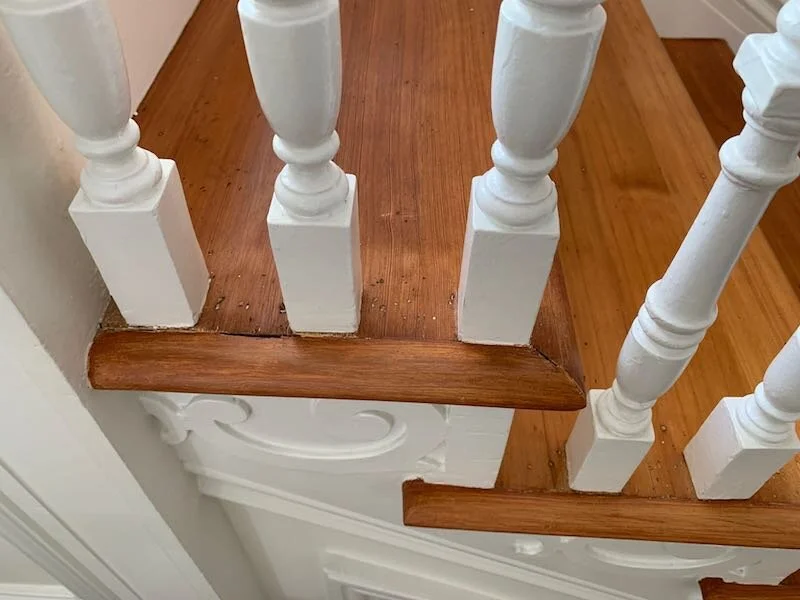
AFTER #1

AFTER #1

BEFORE #2

BEFORE #2

AFTER #2

AFTER #2

BEFORE #3

BEFORE #3

AFTER #3

AFTER #3

AFTER close-up

AFTER close-up

As a fun detail, I also painted in the mitered corner on each step for an added touch of realism!

After close-up of “mitered” corners

After close-up of “mitered” corners

When it was done, the client lifted his glasses, brought his face right up to the stairs and said “WOW!… I can’t tell it’s not wood!


 Enjoy!

Jason

 

Office Space Mural

One of my favorite things to do is design murals, but it can also be fun to work with someone else’s design!  The latter was the case recently, where I painted a 10 foot by 38 foot mural in an office space in Somerville using the design of one of the employees.

Yekaterina Kozlova from tech company SmartBear recently reached out, hoping it would be possible to realize her vision of turning her design into this large mural. The graphic, geometric design and combination of subtle grays with bold colors worked perfectly with the rest of the office space

The original design

The original design

With the design in hand, my job was to make it come to life on the very large wall!

 The biggest challenge was hand-painting shapes that were digitally created, but after a few days of some very steady-handed painting, I was able to accomplish Yekaterina’s goal.  It was fun hearing the overwhelmingly positive reactions from the SmartBear while I was painting the mural, but the most rewarding part was hearing the feedback from the designer herself. When it was done, Yekaterina shared that never imagined it would look as good as it did!

Below are some pictures of the final result — Enjoy!

-Jason

The full mural

The full mural

Close-up of the left half

Close-up of the left half

Close-up of the right half

Close-up of the right half

Ombre, ombre, ombre!

Painting an “ombre” finish means blending colors from the top of the wall to the bottom – usually a dark to light or light to dark of the same color family.  Together with another decorative painter, we did ombre finishes in orange for a company that was renovating a large office space about a year ago.

Fast forward to today, and that same company is renovating another large office space – and this time they decided to go with more ombre walls in more colors (including orange)!

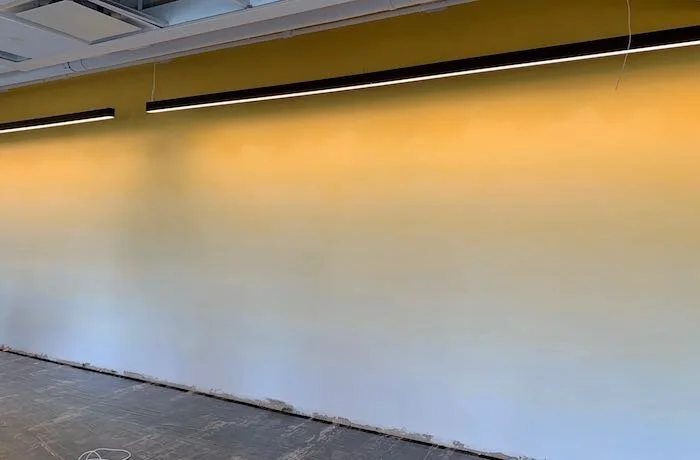
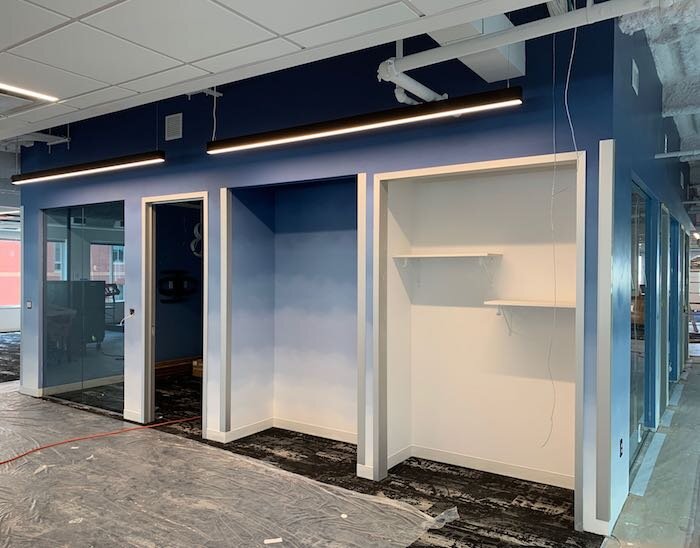
We ombre’d literally thousands of square feet in orange, yellow and blue.  The orange was on two large adjacent walls, plus small accent walls.  The yellow and blue were two large “blocks” of 4 walls each – including a hallway and closets.

To accomplish this look, we started with 9 different shades of each color, painting the walls in jagged stripes of each shade.  With a couple of coats of these jagged stripes done, I then went back and did a wet blend between each of the 2 colors, creating a fade at each step.

 The site is still under construction, but below are some pictures of our completed ombre walls…

Enjoy!

The first step in ombre’ing the walls — before the blend!

The first step in ombre’ing the walls — before the blend!

The final ombre’d/blended wall!

The final ombre’d/blended wall!

Walking around the yellow “block”

Walking around the yellow “block”

yellow closet corner.jpg
yellow monster.jpg
The biggest wall of the blue block

The biggest wall of the blue block

blue corner closet and big.jpg
blue closets.jpg
The orange block

The orange block

Plus small orange accent walls!

Plus small orange accent walls!


Decorative Concrete!

Of the titles I use to describe what I do, “decorative painter” is one that covers the bases of most of my services – except a recent project I worked on using decorative concrete!

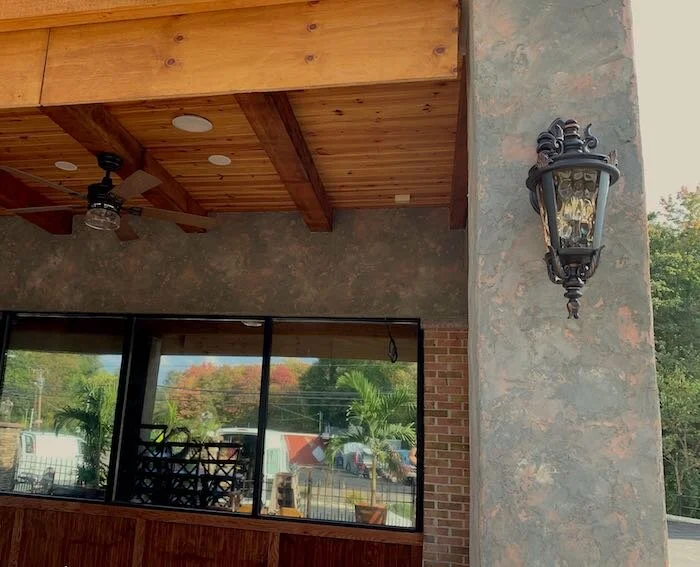
The goal was to give character and interest to columns and soffits in a newly added patio and covered porch at a well-established pizzeria.  The overall look of the restaurant has an upscale, but rustic and old world feel to it – and the plain concrete of these columns and soffits needed a treatment that would make them fit this look.

Rather than simply painting these surfaces, we decided that using decorative concrete would create a more authentic look, adding layers of colors and texture that customers can feel as well as see.  For the colors, we decided to use a gray that would connect to the painted exterior walls of the restaurant, as well as terracotta and light beige tones to tie in with the patio floor.

By building and blending layers of the different colored concrete, the end effect makes the surfaces feel more substantial, aged and authentic – exactly what the owner was looking for!

Below are a few pictures showing the end result.

Enjoy!

Jason

concrete 1.jpg
concrete 2.jpg
Showing close-up of one of the columns (before the inside/back soffit was complete)

Showing close-up of one of the columns (before the inside/back soffit was complete)

In-progress photo showing the texture of the concrete

In-progress photo showing the texture of the concrete

Restoration with Specialty Painting

Often, the creativity I get to apply is in coming up with the design for a mural, decorative pattern, or specialty finish.  Sometimes, though, the creativity required is in figuring out how to replicate or restore an existing finish – which was the case with two recent projects!

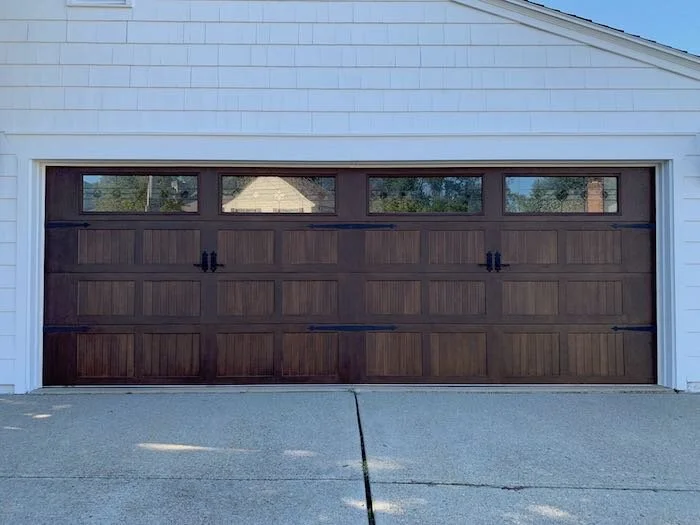
The first example is a garage door that looks like it had a faded finish on mahogany wood.  In reality, the garage door was metal - and the convincing wood-look was created by a photograph of wood that was printed on the metal!  Unfortunately, continuous sun exposure and the elements had faded the printing – in some places all the way to white – creating patchy faded spots all across the door.  The “before” picture is below:

The garage door before restoration

The garage door before restoration

My challenge in this case was how to restore the faded areas without covering over the wood-look that surrounded the light and white areas!  My solution needed some transparency, but also enough opacity to fully cover the white and almost-white spots.  The specifics of my fix will have to remain in my bag of secret-sauce tricks, but with a little bit of experience with similar situations (although none exactly like this one!) and some experimentation, I found a combination of stain, acrylic paint and urethane that did the trick.  When the homeowner stepped out to see the final result, she said “it looks exactly like it did when they installed it brand-new!”

During restoration

During restoration

The final result!

The final result!

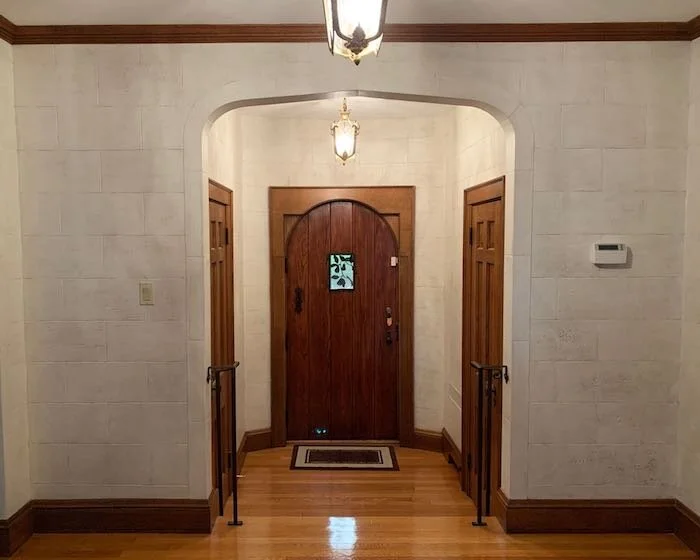
The second example is a decorative lime plaster finish in the entry, stairway and upstairs hall of an historic home in Newton.  Since the finish dated back to the 1920’s, it became stained over the years.  Most of the staining appeared to be from nicotine from previous owners, but there was also a good amount of regular wear-and-tear stains from hands near railings, switches, doorways, etc.  Below is one “before” picture”:

The stairwell before restoration (note discoloration at top of wall and near railing)

The stairwell before restoration (note discoloration at top of wall and near railing)

The big challenge on this job was to somehow cover the stains (they would not wash off!) while maintaining the color subtle variations in the finish as well as a unique glitter/sparkle that was in the plaster!   For this project, I teamed up with another decorative painter – and through a little bit of experimentation, we found a solution using a specialty paint that we watered down, a wax – and a secret ingredient to maintain the sparkle!  The end result hit the nail on the head, covering the stains while still capturing some of the color variation and glitter of the original walls!  As an added bonus, our new finish was sealed – meaning the walls will not stain like they did previously!!

The stairwell after!

The stairwell after!

Front entryway after

Front entryway after

Enjoy!

Jason

Murals of Marble Medallions and Plaster Scrolls

Typically, my projects are either murals or decorative painting jobs – but on this recent project, I was able to use both my mural painting skills and my decorative painting experience!

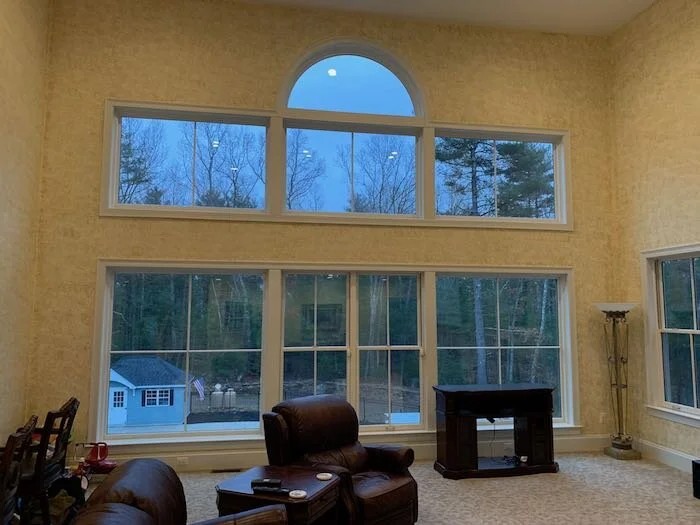
I got the chance to work with interior designer Shawn Strok, who was working with the homeowner to tie in a makeover of their living room with their existing décor, while also elevating the new space for an extra bit of wow factor.  One of Shawn’s main points of focus was the beautiful bank of windows you can see in this before photo:

The room before we got started

The room before we got started

Shawn had the idea to incorporate murals of medallions between the upper and lower windows, and we brainstormed to integrate some of the patterns and colors from a marble inlay in the entrance to the home (see below).

Bogan floor BLOG.jpeg

To cap off the top of the overall composition of windows, drapes and murals, Shawn also wanted to do scrolls on either side of the top, half-circle window. The scrolls create balance for the window treatments while also coordinating with scrolls in wrought iron spindles on a staircase in the room.

As always, I did a concept painting upfront to show all of this, and once that was approved – we were on the final project!  Below is a shot of my concept for the medallion (including faux marbling):

Concept painting for medallion

Concept painting for medallion

 Before I could get started, the room was wallpapered and the trim was painted – giving me a nice clean slate!  My first step was to layout and paint the medallions, creating faux plaster and faux marble looks to add interest and pop.  Below is a shot of all 3 of them, plus a close-up of one to show the detail:

Bogan row of medallions copy BLOG.jpeg
Close-up of medallion mural

Close-up of medallion mural

Then I was on to the scrolls one either side of the half-circle mural.  Here is a close-up shot of one of the scrolls:

Bogan scroll BLOG.jpeg

The icing on the cake was the drapes and cornice.  Here is a final shot of the wall with all steps complete!

Bogan final with curtains BLOG.jpeg

Enjoy,

Jason


Commissioned Portrait to Celebrate a Big Milestone

Often, my clients have me do commissioned paintings as a gift, which means I get to share in a small way in some fun milestones!

This was the case with a recent portrait I did of a married couple who is celebrating their 50th wedding anniversary.  Their daughter, Catherine, originally planned on organizing a fun gathering to celebrate her parent’s big day, but unfortunately the pandemic eliminated that option.  Determined to still find a way to commemorate the day in a special, Catherine got the idea of having a portrait painted – which is when she reached out to me!

The first step was to find an image that would make a good subject for a painting.  For a photo to fit this bill, it should be a good picture of the people – but also recall an important or fun memory.  Fortunately, Catherine had a picture that was a perfect fit!  She sent along this photo below, which was taken while her parents were away at a particularly meaningful vacation:

Catherine orig blog.jpeg

With this as a start point, I then worked on edits to the composition to elevate the image from a snapshot to something worthy of a keepsake.  First, I zoomed in on her parents to get a better representation of their faces.  Then, I suggested I replace the support beam behind her father with a tree to make it less of a distraction and more just a part of the beautiful background.  Finally, I made minor tweaks to the colors of their clothing to make sure the clothes don’t pull too much attention away from the rest of the image.

 Below is the final result.  Catherine was thrilled!  Her first words when I delivered the painting were “that is completely them!!”

Enjoy!

Olender final blog.jpg

Faux Whitewashed Brick Wall

My recent client Nancy had just moved into a beautiful new condo with a water view in East Boston – but she wanted something different to offset the “new white box” feel of the space… which is where I came in!

To keep with the light airiness of the rooms but still add interest, Nancy had the vision of painting one wall in her guest room to look like a whitewashed faux brick wall.  After looking at the wall together and considering the furniture in the room, we decided on a color scheme and I was off to the first step in the process.

Before jumping right to the final project, I start with a concept board to make sure I am accomplishing the look my client is going for.  In this case, Nancy and I had settled on the colors, but discussed both an option where the bricks were close to white as well as an option where the bricks were a little darker (as if the original bricks were dark and showing through the whitewash).  Below is the sample board I showed to Nancy.

Nancy concept board.jpg

Nancy liked all of them, but decided to stick with lightest option that also included shadows under the bricks (option “2b”).

With the selection made – I was on the final faux whitewashed brick wall!  I started by painting the wall the “mortar” color and then added speckles of a darker color to approximate the texture of the concrete.  With this done, I was on the painting the base color of the bricks – which was just a couple of shades lighter that the mortar color.  Similar to the first step, I also added random speckles of a slightly darker color for texture.  To really make the bricks look natural, but still subtle and pretty – I then brushed in touches of a lighter color on each brick.

The final touch was using a glaze of the darker color I originally used for texture in the mortar to create the shadow under the brick.  To create this effect, I needed to hand-paint the shadow under each individual brick!

Nancy was thrilled wit the result and is now enjoying the newest touch of character in her beautiful new home!

Enjoy!

The full wall

The full wall

Close-up view

Close-up view

The final room with furniture!

The final room with furniture!

Custom Commissioned Painting

My recent commissioned painting for a couple in Medway ended up being the proverbial stone to kill 2 birds!

The first “bird” was a blank wall with a utility panel in my client’s newly renovated ground-level basement space.  The space was beautifully done, and the wall with the utility panel was immediately at the entrance – so it was important to my clients to make this space more of a centerpiece than an eyesore!

The second “bird” was an opportunity for a Father’s Day gift!  The wife of the couple had a photo of herself at their Florida home that she knew her husband loved – so the painting fit the bill perfectly as a special gift!

 Below is the picture I worked from and the final painting.

The original photo

The original photo

The final painting!  I needed to change the cropping and add to the sides to make the final composition fit the wider canvas size (30” wide by 40” tall).

The final painting! I needed to change the cropping and add to the sides to make the final composition fit the wider canvas size (30” wide by 40” tall).

Enjoy!

Jason

Unique, Custom Finish of Painted Furniture

So much of what I do is about making things unique, custom and one-off.  For walls, there are plenty of beautiful colors of paint or patterns of wallpaper that can be used to make a space look great – but since anyone can buy the same paint or wallpaper, none of them can make a space truly unique. 

The same is true of furniture.  Creating a specialty paint finish can take a piece from common to custom – from blending into the woodwork to a centerpiece of a room.

My recent client Nikki was in the process of completely re-doing her kitchen – and she wanted to transform her table to go with her new look, but also be something special…. Which is when she called me!

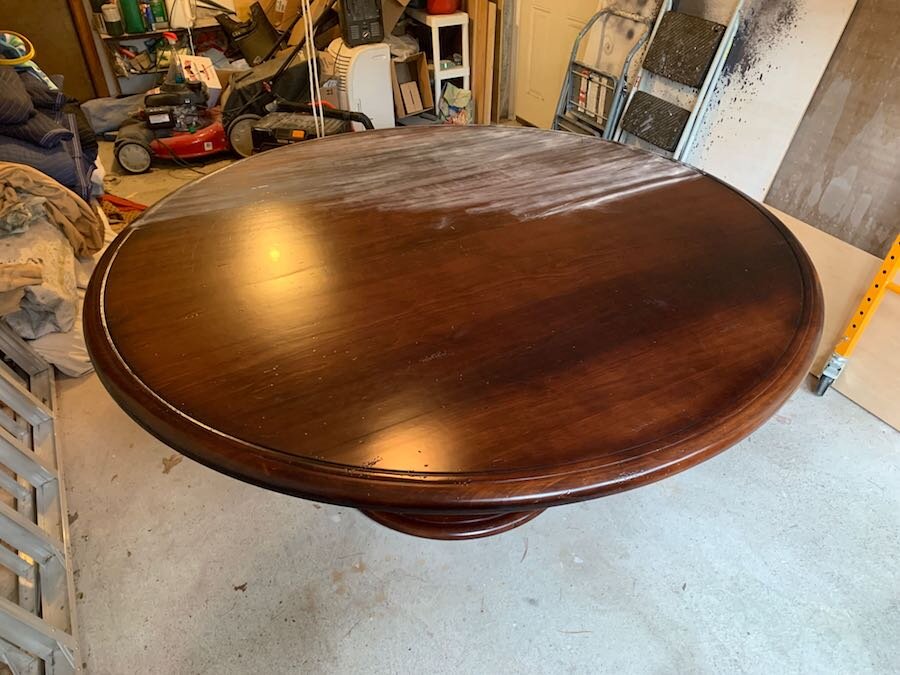
The table Nikki had was a high-quality piece that was in good shape, but the brown finish on the large round (6’ diameter) piece wasn’t working with the look of the space.  To address this, Nikki wanted a distressed finish using colors that would work with her new kitchen.  After talking about options, we settled on a look that would use a blue as the under-color and a gray as the top color.  This way, when the gray is distressed, it reveals the blue underneath.  This looks great, but also references historical pieces that were painted different colors over the years – colors that are then revealed as the most recent paint wears off to reveal the older colors underneath.

Nikki loved the idea – so I was off to working on the table.

As is always the case, the first step was to prep the table by thoroughly cleaning it and then sanding it (to make sure the paint adheres).  After cleaning, I primed the table and then painted the blue that I mixed to get just the right color.  When the blue was dry, I sanded it to keep the finish smooth (which also starts the distressing process).  The primer I used was a slightly lighter color of gray than the final top color – so that any primer that showed in the final finish would add to the depth of the piece.

The original finish. After cleaning, the sanding begins

The original finish. After cleaning, the sanding begins

After sanding, the table was painted with a gray primer, sanded, painted with the blue undercoat and sanded again

After sanding, the table was painted with a gray primer, sanded, painted with the blue undercoat and sanded again

With this layer smooth and cleaned off, I was on to the gray. When painting furniture, I am careful to keep the application as consistent as possible to create a hand-applied look that still looks clean and professional.

When the gray was complete – I moved to the fun part; the distressing process.  When doing this, I am always careful to be very deliberate and light-handed.  You can always distress more, but once you go too far it is hard to fix!  I also focus on areas that would wear from use so the end result looks authentic.  As I did this process, I shared pictures with Nikki to make sure I was accomplishing the look she was going for.

Once the distressing was complete – it was on to the finishing clear-coat!  When doing finishes like this, I use chalk paint because it responds well to sanding and distressing.  However, chalk paint also needs to be sealed – so I use a water-based polyurethane to get a hard, durable finish that won’t yellow (oil-based poly’s yellow very quickly).  Sanding between coats to insure good adhesion, I applied 3 coats of a matte-finish poly, and then I rubbed the final coat with a fine steel wool to give it a mellow, burnished look.

Here is the finished result!

Larkin table final.jpg

Enjoy,

Jason


Art Nouveau Mural in Newton, MA

I love the challenge of bending my style to create murals for all kinds of spaces – which was definitely the case with this dining room mural in Newton!

Cathie main shot BLOG.jpg

My client Cathie was re-doing her dining room and wanted to do something different and dynamic with the wall treatments.  Collaborating with Cathie and her interior designers at Briar Design, we settled on letting the art nouveau details of the house (which was built around time art nouveau was flourishing) influence the design.  Cathie also likes chinoiserie designs, so that also played a role in our choices.

 Below are some shots of the room before we started (note the elaborate iron gate!)


Cathie before 1.jpg
Cathie before 2.jpg
Cathie before 3.jpg

We started by thinking about colors, and to keep with our theme and Cathie’s preferences, we landed on teals and blues.  Cathie also asked to incorporate gold (which was a perfect addition!).  For the subject matter, we decided to incorporate water birds as a nod to chinoiserie.

 With this direction in hand, I started to sketch out ideas and bounce them off of Anne and Jessica at Briar Design.  After some collaboration, we landed on using egrets, lily pads and lotus flowers.  I started my design concept with the organic, curling shapes in the iron gate and built off that.  Here is my first concept drawing that we presented to Cathie:

Cathie wall 1 design BLOG.jpg

Cathie loved the idea (!), so my next step was to take a section of this sketch and show Cathie what our final color selections would look like:


Cathie color concept BLOG.jpg

Cathie was happy with the final concept – so I was ALMOST on to the final mural.  Before I could do that, I had to design the other walls in the room.  Using measurements I took of the space, I did scale renditions for all of the walls:

Cathie wall 2 design BLOG.jpg
Cathie wall 3 design BLOG.jpg
Cathie wall 4 design BLOG.jpg

With this step done, NOW I was on to the final mural!  It was a blast to watch this mural unfold, and truly a pleasure to work with Cathie and her husband. Anne and her team are still working on next steps for the rest of the design (including sconces in the holes on one of the walls, new chandelier, etc) – but here are final pictures of the art nouveau walls!

Wall 1

Wall 1

Walls 1 and 2

Walls 1 and 2

Wall 2

Wall 2

Walls 2 and 3

Walls 2 and 3

Wall 3

Wall 3

Wall 4

Wall 4

And back around to the first wall with the corner of wall 4

And back around to the first wall with the corner of wall 4

Enjoy!

Jason

A Mural to Set the Mood at Local Tea House in Millis, MA

When I work with clients who want a mural painted, a couple of the common goals are to make their space special when people visit and memorable after they leave.  This was definitely the case with my most recent mural project for a tea house and café that is opening soon!

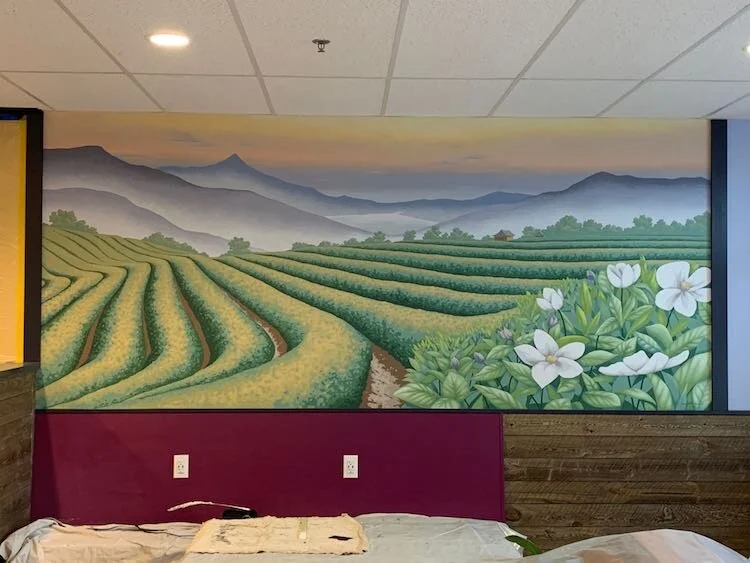
When my client Ed was planning the space for his up-coming Nirvana Tea House & Café in Millis, MA – he wanted it to have a little of the magic he experienced while visiting tea fields in Asia.  To accomplish this in a way that people would be sure to enjoy and remember, he asked me to make a centerpiece in his café with a 6’x13’ mural of a tea field!

When I met with Ed in the space, our first order of business was to figure out the mood and colors that would be the best fit for the mural.  For the mood, Ed wanted to capture the spiritual and inclusive nature of his motto “Inviting the world to tea”.  For the colors, Ed  already had a fantastic fabric from Bhutan picked out for the cushions on his seats, so we used that as our guide for colors in the rest of the café – and in turn the mural. 

To create a quiet, contemplative mood and to capture some of the beautiful jewel tones of purple, orange and yellow in the fabric, I decided to focus on a scene at sunset.  This set me on my way to finding images I could use as inspiration, which I shared with Ed to come up with a look that fit his vision.

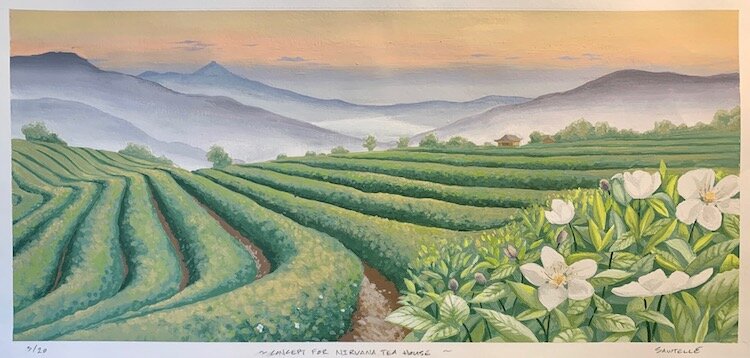
Once I was confident I knew what Ed wanted, I moved on to my “concept painting” stage – where I do a scale painting of the mural design I am proposing with the actual paints I would use for the final project.  Below is an image of this concept painting:

8” x 18” concept painting

8” x 18” concept painting

We met again in the space to look at this concept together and Ed loved it! With my design approved, I was on to painting the final mural.  Below are various stages of the process – starting with the blank wall:


The blank wall pre-mural

The blank wall pre-mural

After 3 days of drawing and painting

After 3 days of drawing and painting

Action shot on day 4

Action shot on day 4

Action shot on day 5

Action shot on day 5

N blog 2.jpg
Action shot on day 6

Action shot on day 6

Day 7

Day 7

N blog 4.jpg
Day 8

Day 8

The foreground close-up of the tea plants took over 3 days to paint!

The foreground close-up of the tea plants took over 3 days to paint!

Done painting! I came back to do a protective clear-coat

Done painting! I came back to do a protective clear-coat

Foreground detail

Foreground detail

And here is the final result after Ed had the ceiling painted to match the darker purple trim in the café:

Nirvana final 2 blog.jpg

As another fun note on this project, Ed also had me create the logo for Nirvana!  Our main objectives with the logo were to make something that would capture the sprit of Ed’s tag line “Inviting the world to tea” and would also be identifiable and memorable.  After some brainstorming around different approaches, below is the final logo that will soon adorn Nirvana Tea House & Café!:

Nirvana logo and type blog.jpg

Enjoy!

Jason

Setting the Tone for Law Office Clients with a Mural

Why go through the effort and expense of having a mural painted in your office? For my clients at Next Phase Legal in Norfolk, MA, it was about beautifying their lobby while creating a lasting impression and setting a tone for their clients.

Indeed - in the week while I was painting it, I heard comments from clients visiting the firm that ranged from “beautiful” to “soothing”, “relaxing”, “mesmerizing” and “memorable”… Mission accomplished!

My client Steve first came to me with a quote from Seth Godin that is a perfect stage-setter for the dispute resolution work they do at Next Phase:

Peace might not mean getting everyone else to do what you want them to do. Instead, it might involve understanding that others don't always want what we want and don't often believe what we believe. Most of the time, people want to be seen, understood and appreciated. If we can offer someone dignity, we give them a gift that's difficult to find.”

Steve’s goal was to create something special and he knew he wanted more than just the quote painted on the wall – so we met to brainstorm ideas.  After bouncing around a few thoughts, we landed on the idea of incorporating an image of water together with the quote.  Steve and I share a passion for paddling, but we also liked the engaging and soothing qualities of water to complement Seth Godin’s words.

With this idea and the lobby colors in hand, I was off to paint a concept sketch. To accommodate designs with type, I take an image of my completed concept painting and combine it with type in PowerPoint to show what the final result with image and type will look like.  This also enables me to easily look at different fonts together with my clients without altering the concept painting. Below are the concept painting and the PPT.

The scale concept painting

The scale concept painting

Concept with type

Concept with type

Steve loved the painting and after looking at a few font options, we had a winner! 

When I paint the concept, I use actual wall paints and keep record of exactly what I use – so once the concept is approved I know exactly what I need to do on the wall!  For anyone familiar with my fine-art paintings, you already know how much I love painting water – so this was a fun mural to paint!! Below is the final mural

The final mural

The final mural

Enjoy!

Jason

Custom Paint Finish for a Guitar

It’s a rare that I can combine my passion for art and my love of music (and guitars!), so my latest project of creating a custom finish on an electric guitar was a special treat!

I started with a raw-wood guitar body cut in the shape of the iconic Fender Telecaster – a blank canvas with no direction other than to make it a one-of-a-kind guitar.

Fender has used many fantastic colors over the years, so I started by looking through some of the older “classic” colors from the 50’s, 60’s and 70’s.  While my goal was not to exactly match these colors, I found inspiration in colors like “Sherwood Green”, “Daphne Blue” and “Aged White”.  I also have always been partial to what is called a “Relic” finish – which is a new finish created to look like it has already seen years of use.  I love this “Relic” look largely because of my affection for one of my own instruments from 1979 that has a high level of real-use wear.

In addition to some of these tried and true ideas, I also wanted to add my own custom touch.  I didn’t want to add anything too large or detailed because I was concerned the overall look would get too busy with both a design and the relic treatment.  After playing with a few ideas, I landed on something near and dear to me – crows! At first, the crows were just black profiles (like on the ceilings of a few of my murals), but to better go with my color scheme, I used a dark grey in place of the black.   I then decided to add a little depth and detail (but not too much!) by highlighting half of each crow – as if they were flying in the sun.

With my design complete, I was on to painting the final product.  I chose to use the Daphne Blue and Aged White as under-colors – as if the guitar had been painted and re-painted over its lifetime, with the green as the final color.  I then looked at my own old guitars to replicate patterns of wear, carefully sanding down the top layers to show the colors underneath.  Once I completed this, I then went on to may favorite part and drew and painted the crows.

With the basic finish complete, I finished with a few coats of a clear finish that I then also relic’d to add protection while still looking aged.

For a bit of fun, I capped it off by naming it the “Crowcaster” to incorporate the unique design with the original Telecaster model name.

And here is the final result!

Crowcaster full blog size.jpg
Crowcaster close blog size.jpg
Crowcatser headstock blog size.jpg

Enjoy!

-Jason

Making Kid's Room Murals Magical AND Long-Lasting!

I was recently talking with a real estate agent about painting kids’ room murals and she mentioned that while it was a great idea, it seemed difficult to justify the spend for something that would only last a couple of years!  This got me digging through some old photos, as well as taking some updated shots…

Mia’s Mural in progress in 2003 (with Mia’s Mom and Mia on the way!)

Mia’s Mural in progress in 2003 (with Mia’s Mom and Mia on the way!)

Mia (now 16), her Mom and the mural in 2020

Mia (now 16), her Mom and the mural in 2020

The rest of Mia’s mural

The rest of Mia’s mural

Mia, a good book and her Mallard

Mia, a good book and her Mallard

Beck (4) and Mia (6) with Beck’s undersea mural in 2009

Beck (4) and Mia (6) with Beck’s undersea mural in 2009

Beck (14) and Mia (16) with Beck’s mural in 2020

Beck (14) and Mia (16) with Beck’s mural in 2020

Beck on the move and his turtle in 2009

Beck on the move and his turtle in 2009

Beck and his turtle today

Beck and his turtle today

The murals in the pictures above have been loved for over 16 years (Mia’s sky mural) and over 10 years (Beck’s undersea mural).

When considering a mural for kids’ rooms, there are two main questions:

1) What is the value of doing a mural in the first place? - and

2) How do you make it last (like these did!)?

To answer question #1, I decided to ask Mia and Beck for their first-hand experience…

They shared that when they were little, they felt their room was “cool” and “special” and they loved bringing friends to show them the murals.  They always felt comfortable in their rooms and saw them as a “happy” space. Mia thought of the birds in her mural as actual birds, and used to saying goodnight to them every night, while Beck shared that he used to give the sea creatures in his room personalities. In addition to this alone time and time shared with friends, the murals also played role in the time they spent with each other - as one of their favorite games was to run back and forth between the rooms to “travel” from sky to undersea and back again!

Moving on to question #2 about making a mural last, Mia and Beck gave some good insight here as well.  Mia said she would never paint over her mural because it is part of her memories as a kid, but also because the meaning of the mural has become more and more important to her.  When the mural was painted, each bird stood for important people, including the crow, who stood for her grandfather and the finch who stood for her father’s best friend Randy.  Unfortunately, both her grandfather and Randy died before Mia was born – so Mia likes to look at the birds and think about the stories she has heard about these special people.

So – the key to making a mural that will be cherished AND will last?  Make it special!  Unlike wallpaper or stick-on decals, painting a mural offers the opportunity to customize the space you create for your children. With some thought and planning, your children can be excited and inspired by their happy space for many years to come.

As a staring point in this planning process, following is a link to a list of 5 things to consider that I first published back in 2015: https://www.blackbeakstudios.com/blog/2015/8/3/5-things-to-consider-when-planning-a-kids-room-mural

Most importantly, bring your love and personality to the project and both you and your kids are bound to enjoy it while you watch them grow up (way too fast).

Enjoy!

Jason

Ombre Painting Spices Up Office Renovation

I often get to collaborate with clients and with designers, but I recently had the opportunity to also work with another decorative painter – which was a lot of fun!

As part of a large office space renovation (the same office space I did the “sketch” murals for), the designer and the client decided that for a number of the accent walls throughout the space, they wanted them painted with an ombre finish.  The company’s color is orange – so the concept was to create a gradation in tones of orange to create an eye-catching but soft and pleasing look for several of the (very) large walls throughout the space.

The challenge was scheduling.  Due to the many moving pieces in this large renovation and the hard deadline for the business to move in – the deadline on the ombre walls was tight!  My friend Joan was called in as the decorative painter to get this work done, but because of the tight schedule, she called me in to help!

Since I usually work alone, it was a nice treat to work with a crew of people.  Joan has another painter on her team, Rich, who prepped the walls for us and painted stripes of 4 of the different shades of orange to give us a good base to work with for the ombre.  Joan and I then moved through with 8 (!) shades of orange to help create a soft blend.

To make things efficient with the many colors we were using, my job was to go through first on the bottoms of the walls, blending from the white at the bottom up to the 5th darkest color.  Joan then followed and blended from the top down to my darkest color.

Not only did this process do the trick in terms of meeting the deadline, we also hit the mark for the look the client wanted!  Each day the customer walked by drew another compliment – my favorite of which was that he wanted to hug the walls!

Following are some shots of the final result.  Enjoy!

ombre 1.jpg
ombre 2.jpg
ombre 3.jpg

Enjoy!

Jason

A Specialty Paint Finish for an Entertainment Cabinet

Sometimes my specialty paint finishes can help create a focal point for a room, where in other cases my job is to complement and/or “complete” a look that already exists in a space.  My recent project creating a specialty finish on an entertainment cabinet in Boston was a fun challenge for the latter scenario.

I was brought in to this project by an interior designer friend to help her clients “fix” a set of doors and drawers that they felt looked too much like a filing cabinet!  The entertainment center is in the primary living space of a condo in South Boston that had been recently renovated, and while the upper section includes a venetian plaster finish, the lower cabinets’ simple light gray paint didn’t work with the overall look.

Below are pictures of the cabinet before I started:

Tanna before 1.jpg
Tanna before 2.jpg

My first step was to collaborate with the designer and the client on a solution.  They knew they wanted something to pick up on the patterning of the venetian plaster, but using plaster on the drawers and door faces would not be a durable solution.  To address this, I suggested creating a similar patterning with paint and glaze that I could them polyurethane for great durability.  For colors, we looked at the wallpaper, the venetian plaster and the counter top and decided to shoot for a gray that pulled in all of these elements without being too matchy.  To accomplish this, we aimed to go darker than the top section but not as dark as the counter – all while keeping the grays in the same general family as the wallpaper.

As always, my first step was to create sample boards.  In this case, I did four different color combinations to give my clients plenty of options to choose just the right look.  When we met to review the options, there were a couple of close finalists, but we were able to pick and option they were happy with!

With this in hand, I was ready to move forward with creating the look on the cabinets.  Since I record all of my color and techniques for samples, I just needed to use the same formulas for the cabinets.  As always, I cleaned and sanded to make sure I got good adhesion with me new paint.  I panted my base layer, then created the patterning with a second color.  When this was dry, I finished it all off with 3 coats of acrylic poly to get a good, hard finish that won’t yellow.

When I returned to re0assemble the cabinets, my clients were thrilled to no longer have the “filing cabinet” look! Below are the “after” pictures.

Enjoy!

Jason

Tanna after 1.jpg
Tanna after 2.jpg

Murals Based on Historical Images for an Office Redesign

As I was in the midst of working on my most recent mural project, the designer walked by and commented that I seemed like “such a happy man”.  Truth is, she was right – I truly love working on murals!

This project was for an office redesign in Cambridge, MA.   To help make the space special, the facilities manager wanted the walls to include two hand-done custom murals based on historical images of the Cambridge area.  The tricky part was that they needed them done in just over 2 week

As always, I started the process by collaborating with my clients on the look they were going for.  The designer shared historical photos they liked and showed me the walls – one needing a 20’ mural and the other a 30’ mural!  Based on these initial conversations, I did a painting concept for one wall, but also included a sketch to show an alternate composition.  While they liked the painting, they were intrigued by the sketch – and wanted to know if I could do a mural that looked like a sketch, and if it would take me less time than the painting.  The answer to both was “yes”!  To do both murals as full painting, I would not have been able to meet the deadline, but with the new approach it was possible!

The only challenge was I then needed to figure out how to translate the look of pencil on paper to a 20’ and 30’ wall.  One of the key considerations was that I needed the line work to be much thicker than a pencil to work on the large scale.  I did some experimenting and landed on using pastels.  The pastels gave me the nice thick lines, and by using various shades of gray, I could also create depth by using lighter colors in the background.

My remaining challenge, however, was how to make sure my drawing wouldn’t just rub off the wall when I was done!  Again, after some experimentation, I discovered a multi-step process with acrylic polyurethane – using spray, gentle brushing and then rolling to create a completely durable finish in the end.

For the content of the murals, I started with photos of Craigie Bridge and Oak Square – making tweaks to fit the space.

In the end, I was able to give my client the look they wanted AND meet the deadline! … And I loved doing it.

Following are pictures of the final result.  Enjoy!

20’x9’ mural of Craigie Bridge

20’x9’ mural of Craigie Bridge

30’x9’ mural of Oak Park

30’x9’ mural of Oak Park

Oak Park mural

Oak Park mural

Oak park mural detail

Oak park mural detail

Oak Park mural detail

Oak Park mural detail

Decorative Paint Repairs To The Rescue!

While I love my creative projects, I also truly enjoy the challenge of my unique specialty painting repair projects!

One of my recent challenges was to fix a floor that had recently been refinished.  In the process of finishing the stairs, certain sections of the landing did not accept the stain and the floor was then polyurethaned – leaving spots that looked worn, but actually had a poly coat on top of them.  The best fix would be to re-sand the floor all the way down to bare wood and start over – BUT, the problem was that the flooring was actually plywood in this area, so it was not an option to sand it any further as it would have taken off the veneer!

Rather than ripping up the old floor and starting over, I was called in to work “magic”!

Since there was polyurethane over the worn spots, re-staining was not an option.  Instead, I used acrylic paints to tint polyurethane and put my tinted poly over the existing finish.  My favorite part of things like this is matching the color – so once I had a great match, I was on to carefully addressing the patches.

In doing this, the biggest challenge is overlap.  While you want the tinted poly over the worn areas, you DON’T want it to touch the existing stained areas – as that would just make those areas darker and create a dark outline around the fixed spot. This meant using my finest brushes in some areas, but also meant I needed to blend the edges in other areas – using everything from water to my fingers to make the blend seamless.

To get the depth of the color correct, I needed to let my poly dry and then do a second coat – following the same process as I did for the first coat.

Finally, I wanted to make sure the shininess of the finish was consistent – so when my second coat was dry, I re-poly’d the entire section.  The original floor had a matte finish, so I also used a matte poly – BUT, as it turned out, my matte poly was slightly shinier than what was originally used.   To address this, I waited for my poly to dry and I then rubbed it gently with super-fine steel wool to cut the sheen slightly.

 In the end, I got both the color and the sheen to match – and the client was thrilled to avoid the costs of replacing the floor!

 Below are some before and after pictures — 

Before

Before

After

After

Before

Before

After

After


Enjoy,

Jason
Faux Painted Horn Tiles on a Wayland, MA Ceiling!

For my decorative painting work, I do plenty of “traditional” faux finishes – but I love when get to create completely new faux paint designs!

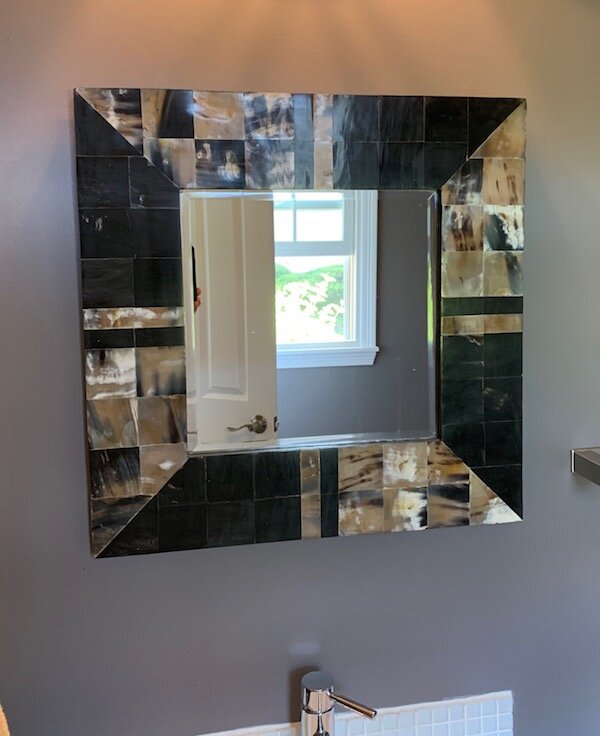
This was the case with my recent project for my client Jodi.  Jodi wanted to do something dramatic and fun with the ceiling in her powder room, but at first she wasn’t sure exactly what to do.  When we met, she was thinking of doing a gold finish, but then she looked at her mirror and asked if we could do something that picked up on the look of the horn tiles that make up the frame of the mirror (see picture below).  My answer was an enthusiastic YES!

The inspiration

The inspiration

Since Jodi was going for drama and fun, I loved the idea of blowing up the look of the tiles and replicating it on the ceiling.  As I looked at the space, my one concern was that the look could lose some of the drama as it met the grey walls, so I recommended we do a white border to frame the tiles – and Jodi was immediately on board.

As always, my first step was to do a test board – showing a small version of the tiles on a 2’x2’ panel to make sure the look I envisioned was in line with what Jodi wanted. The “tiles” in the ceiling ended up being about 20”x20”, so I did a scale version with 10”x10” squares to give Jodi a good idea of how the abutting tiles would look.  When we met to look at the concept, Jodi said; “I love it!” – and I was on to the final project!

My first step on-site was to do all of my measurements to make sure I could make a consistently sized border and fit in 12 evenly sized square(ish) tiles.  To make this work, I laid out the border and then created a template for the squares (which needed to be slightly off square at 19.5”x19.75”) so I could make sure everything would fit.  I then taped the border and painted a base coat of a medium tan in the field where the tiles would go.

With the tiles drawn out and taped, I was then on to painting them!  Unlike many faux finishes – there was no specific technique to create this look.  Each square ended up being a mini-painting of a horn tile that I created by just blending paints like I would in a painting or mural.  As I worked my way around the ceiling, I mapped out different grain directions and colors to make sure the overall effect was balanced but dramatic.

Once this step was done, I finished it with a high-gloss coating to really make it pop!

 Enjoy,

Jason

The final ceiling!

The final ceiling!